
Table of Contents
- Soy Wax vs Beeswax: Quick Comparison
- Melting Point and Burn Time
- Scent Throw in Soy vs Beeswax Candles
- Best Wax for Candle Making: Performance and Ease
- Candle Wick Sizing for Different Waxes
- Cost, Sustainability, and Environmental Impact
- Which Wax Should You Choose?
- Frequently Asked Questions
Last Updated: October 4, 2026
Soy Wax vs Beeswax: Quick Comparison
When you're deciding between soy wax vs beeswax for candle making, you're really choosing between two fundamentally different approaches to the craft. Soy wax is a renewable, plant-based option that's become the standard for most modern candle makers. Beeswax, the traditional choice, offers unique performance characteristics that soy simply can't replicate. At Forth & Nomad, we've worked with both materials through our custom Candle Bar, and the differences go far deeper than just where they come from.
The choice between these two waxes shapes everything: how your candle burns, how far the scent travels, how long it lasts, and ultimately how much you'll spend. Neither is universally "better", each excels in different scenarios. Here's what you need to know to choose correctly.
| Feature | Soy Wax | Beeswax |
|---|---|---|
| Source | Soybean oil (renewable) | Honeycomb (animal product) |
| Melting Point | 160-180°F | 147-149°F |
| Burn Time | 7-9 hours per ounce | 5-7 hours per ounce |
| Hot Throw | Moderate to strong | Naturally strong |
| Cold Throw | Moderate | Weak to moderate |
| Cost per Pound | $4-8 | $12-25 |
| Sustainability | Plant-based, renewable | Limited supply, ethical concerns |
| Best For | Scented candles, beginners | Unscented, decorative, premium |
Melting Point and Burn Time
Beeswax has a lower melting point (147-149°F) than soy wax (160-180°F), which means it liquefies faster and creates a wider melt pool as it burns. The difference matters more than it sounds.
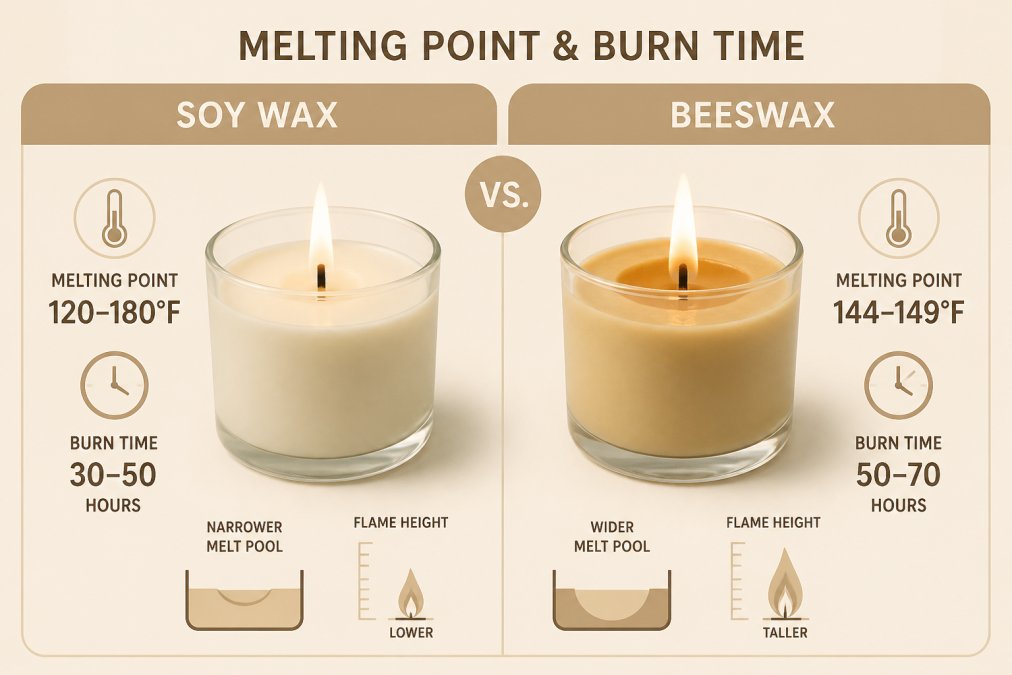
Soy wax's higher melting point means it holds fragrance oils more efficiently during the burn. When you add fragrance to soy wax, the oil disperses evenly and releases gradually as the wax melts. Beeswax, by contrast, can cause fragrance oils to volatilize too quickly, another reason beeswax candles are traditionally unscented.
For beginners, soy wax is more forgiving. It's harder to overheat, easier to pour at lower temperatures, and less prone to separation when fragrance oils are added. Beeswax requires more precision: if you overheat it, the wax can discolor and become brittle. If you add too much fragrance oil, it won't blend properly and will separate during cooling.
Scent Throw in Soy vs Beeswax Candles
Scent throw is where soy wax shows its real advantage, and understanding why requires looking at the chemistry beneath the surface. Soy wax's lower viscosity (approximately 25-35 centipoise at pouring temperature) allows fragrance oil molecules to disperse evenly throughout the molten wax. This uniform distribution means fragrance releases consistently during both the hot throw phase (when the candle is lit) and the cold throw phase (when unlit).
Beeswax operates differently. Its higher viscosity (approximately 40-50 centipoise at pouring temperature) resists thorough mixing with fragrance oils. When you add fragrance to beeswax, the oil tends to remain in discrete pockets rather than fully integrating, leading to uneven scent distribution and unpredictable throw.
Cold throw with beeswax is weak to moderate even without fragrance added. If you want a candle that smells good sitting on a shelf, soy wax is the better choice. The National Candle Association recommends soy wax blends for scented container candles because the wax's performance with fragrance oils is simply more reliable.
Troubleshooting common scent throw failures:
If you're blending soy and beeswax and experiencing weak cold throw, the issue is usually beeswax dominance. Solution: reduce beeswax to 20% or lower, or increase fragrance load to 6-8% (standard is 5-6% for soy alone). Test in small batches first.
If hot throw is uneven or fades quickly when using beeswax, you've likely exceeded the fragrance saturation point. Above that threshold, fragrance pools at the bottom or sides of the candle. Solution: reduce fragrance to 4% or blend with soy wax to increase the blend's fragrance capacity.
If you're adding fragrance to pure beeswax and the scent smells harsh or chemical, the honey notes are being masked. Strong synthetic fragrances overpower it. Solution: use fragrance loads below 3% for beeswax, or choose fragrance profiles that complement honey (vanilla, floral, amber notes work better than citrus or herbal).
Best Wax for Candle Making: Performance and Ease
For most candle makers, especially beginners, soy wax is the better choice. It's forgiving, affordable, and performs reliably with fragrance oils. You can pour it at lower temperatures, mix it with fragrance without complications, and achieve consistent results batch after batch.
Beeswax demands more skill. It requires precise temperature control, careful fragrance handling, and acceptance that you're working with a material that performs best unscented. But for makers who want to create premium, long-lasting decorative candles or are committed to traditional candle making, beeswax offers something soy can't: a natural honey aroma and the prestige of a heritage material.
The performance difference becomes clear once you light them. A soy wax candle with proper wick sizing burns cleanly and releases fragrance evenly. A beeswax candle burns with a brighter flame and produces a subtle honey scent. Neither performs "better", they perform differently, and the right choice depends on what you're trying to make.
Consider what you want your finished candle to do. Are you making scented candles for gifting? Soy wax. Are you making decorative, unscented candles for display or as heirloom pieces? Beeswax. This distinction shapes every decision that follows.
Candle Wick Sizing for Different Waxes
Wick selection is where many candle makers stumble, and the wax type directly determines which wick you need. A wick that works perfectly in soy wax will create tunneling in beeswax, the candle will burn straight down the center, leaving wax on the sides unburned.
The rule of thumb: for beeswax, use a wick one size smaller than you would for soy wax of the same diameter. If you're making a 2-inch diameter soy candle with a size 4 wick, drop to a size 3 for beeswax.
Strawberry Beeswax Birthday Candles →
Soy wax tolerates wider wicks and thicker braiding because it burns cooler. This gives you more flexibility when prototyping. You can test a wick, adjust it, and retest without wasting as much material. With beeswax, every test uses more wax and demands more precision.
Wick material matters too. Cotton wicks work well in both, but braided cotton performs better in beeswax. Paper-core wicks, which are common in soy candles, can burn too hot in beeswax and create excessive mushrooming at the wick tip.
Cost, Sustainability, and Environmental Impact
The price difference is stark and immediate. Soy wax costs between $4-8 per pound wholesale, while beeswax ranges from $12-25 per pound depending on purity and source.
Lifecycle carbon footprint and agricultural impact:
Sustainability claims require looking beyond marketing language to actual environmental trade-offs. Soy wax is plant-based and renewable, but large-scale soy farming carries documented environmental costs: deforestation (particularly in South America), pesticide use, and monoculture agriculture that reduces biodiversity. Additionally, soy wax requires hydrogenation, a high-temperature, high-pressure chemical process using hydrogen gas, to convert liquid soybean oil into solid wax.
Beeswax is harvested as a solid from honeycomb and requires minimal processing (filtering and sometimes light bleaching). This means lower processing emissions per pound. However, beeswax supply is limited: a single hive produces only 1-2 pounds of surplus beeswax annually after the colony's own needs are met. Large-scale beeswax harvesting can stress honeybee colonies if done unsustainably, reducing their ability to overwinter or maintain population health.
Research from the Environmental Protection Agency on sustainable materials and lifecycle analysis studies in the candle industry show that soy's renewable nature is partially offset by agricultural impact (deforestation, pesticide runoff, processing energy), while beeswax's minimal processing is offset by limited supply and the ecological stress of large-scale harvesting. Neither wax is carbon-neutral; both carry trade-offs.
Regulatory standards for labeling blends:
Making a sourcing decision:
For makers committed to sustainability, the honest answer is that neither wax is perfect, but the choice depends on your values and sourcing options. If you prioritize renewable resources and can accept agricultural impact, soy wax is the pragmatic choice. If you prioritize minimal processing and supporting ethical apiaries, beeswax from a trusted local or certified-sustainable source is worth the cost premium.
At Forth & Nomad, we've chosen soy-based wax blends for our candles like the Vetiver & Fig Candle and Blood Orange & Teak Candle because they deliver consistent scent throw and performance for our signature fragrances. When we wanted to create something special with beeswax, we made it unscented, like our Strawberry Beeswax Birthday Candles, which celebrate the material's natural honey aroma and heritage craftsmanship without the complexity of fragrance integration.


Which Wax Should You Choose?
Choose soy wax if you're making scented candles, you're new to candle making, or you want predictable results with fragrance oils. It's affordable, forgiving, and performs reliably. Most commercial candle makers use soy wax for these reasons.
Choose beeswax if you're making unscented decorative candles, you value traditional materials, or you're willing to invest time learning to work with a more demanding material. Beeswax candles become heirloom pieces, they burn longer, look premium, and carry the subtle honey scent that only beeswax provides.
The decision between soy wax vs beeswax for candle making ultimately comes down to what you're making and how much you want to invest in the process. Neither is wrong. They're simply different tools for different jobs. Start with soy if you're exploring the craft. Move to beeswax when you're ready for the next level of precision and premium results.
Frequently Asked Questions
What are the primary performance differences between soy wax and beeswax?
Soy wax and beeswax differ significantly in melting point, burn time, and scent throw. Beeswax burns cleaner. Soy wax offers better scent throw, especially cold throw. Beeswax produces a natural honey aroma and burns brighter, while soy wax requires fragrance oils for scent. Both have distinct advantages depending on your candle-making goals.
Is beeswax or soy wax better for scent throw?
Soy wax typically offers superior scent throw compared to beeswax. Soy wax's lower viscosity allows fragrance oils to disperse more effectively throughout the melt pool, creating stronger hot throw and cold throw. Beeswax naturally produces a honey scent and doesn't hold fragrance oils as readily, making it less ideal for heavily scented candles. If scent strength is your priority, soy wax blends are the better choice. Our Vetiver & Fig and Blood Orange & Teak candles use soy-based blends specifically to maximize fragrance delivery.
Which wax is more sustainable for candle making?
Sustainability depends on your priorities. Beeswax is a natural, renewable byproduct of honey production with a natural honey aroma, no synthetic fragrance needed. However, large-scale beeswax harvesting can stress honeybee populations. Soy wax comes from soybeans, a renewable crop, but soy farming often involves pesticides and monoculture practices. Soy wax is generally more affordable and easier to source sustainably. Neither is perfect; consider supporting beekeepers or sourcing soy from certified sustainable farms to minimize environmental impact.
Do beeswax candles require different wicking than soy wax?
Yes, beeswax and soy wax require different wick sizing due to their different burn characteristics. Beeswax burns hotter and cleaner, so it typically needs a slightly smaller wick to prevent mushrooming and tunneling. Soy wax, which burns cooler, usually requires a larger wick to achieve a full melt pool and proper scent throw. Wick size also depends on container diameter and candle height. Testing is essential, start with a wick size recommended for your specific wax type and adjust based on burn performance to avoid common issues like tunneling or excessive smoking.
If you're ready to explore candle making without the learning curve, Forth & Nomad's custom Candle Bar lets you craft personalized candles with expert guidance. We handle the wax selection and wick sizing, you focus on the fragrance and design. Shop our signature candles to see how the right wax choice elevates the final product, or visit us to create your own.